The demo worked, production data broke it
The model handled the clean sample set. Real inputs, edge cases and bad formatting expose it fast.
A model, a prototype, or a vendor trial proved the idea could work. Six months later it's still sitting in a sandbox because nobody will sign off on putting it in front of real customers or real decisions.
The signs usually show up in day-to-day work long before anyone names the problem.
The model handled the clean sample set. Real inputs, edge cases and bad formatting expose it fast.
Leadership won't approve a system whose outputs can't be traced back to a reason.
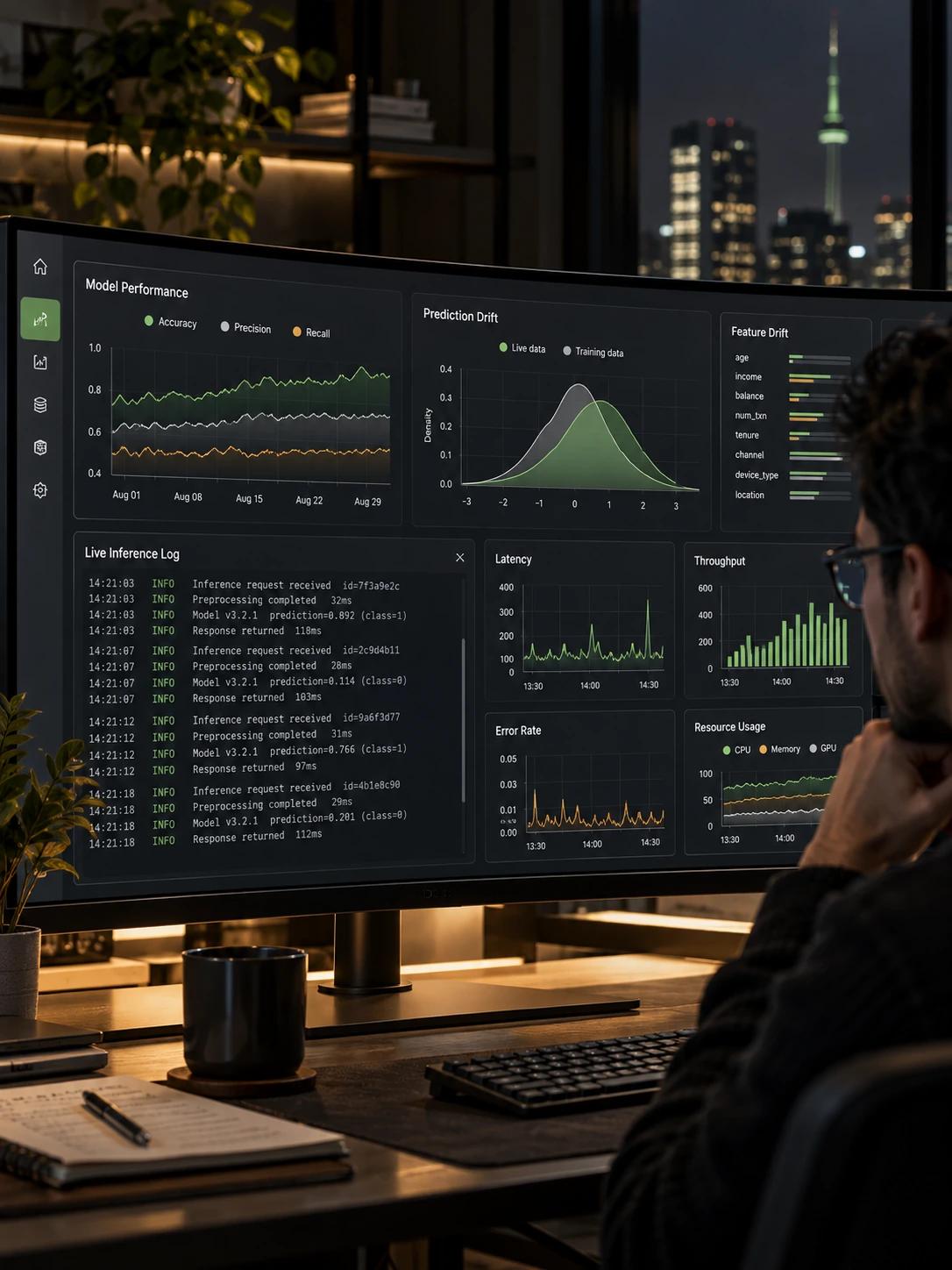
A pilot built to prove a point was never built to be watched in production.
The pilot lives in a data scientist's notebook or a single engineer's side project.
Most pilots are trained and demoed on a curated slice of data. The moment the system meets live inputs, variants, missing fields, inconsistent formats, the accuracy drops and trust drops with it. Nobody budgeted time to handle the messy 20%.
Most AI pilots are scoped to answer "can this work at all," not "can this run the business." That's a reasonable first question, but it leaves out everything production needs: monitoring, evaluation, a retraining path, and a clear chain of accountability for a wrong answer. Without a second phase built for those requirements, the pilot stalls in permanent evaluation.
Leadership loses confidence in AI generally, not just this one project, making the next initiative harder to fund.
The team that built the pilot moves on to other work, and the knowledge needed to finish it leaves with them.
Competitors who get a narrower, production-grade system live first capture the operational advantage while the pilot sits in review.
We clarify the decision the model needs to make or the cost it needs to cut, and the delivery constraints around it, before touching architecture.
We define the smallest model or system that reliably delivers that outcome, with retrieval over your own data and guardrails instead of a black box.
We build a tight first release scoped for production, not another demo, with clear ownership and visible tradeoffs.
Monitoring, evaluation and a retraining path ship with the system, so performance is tracked and the model keeps working after launch.
What day-to-day work looks like once the fix is in place.
Tell us where the project stalled and we'll tell you what it takes to ship it.